
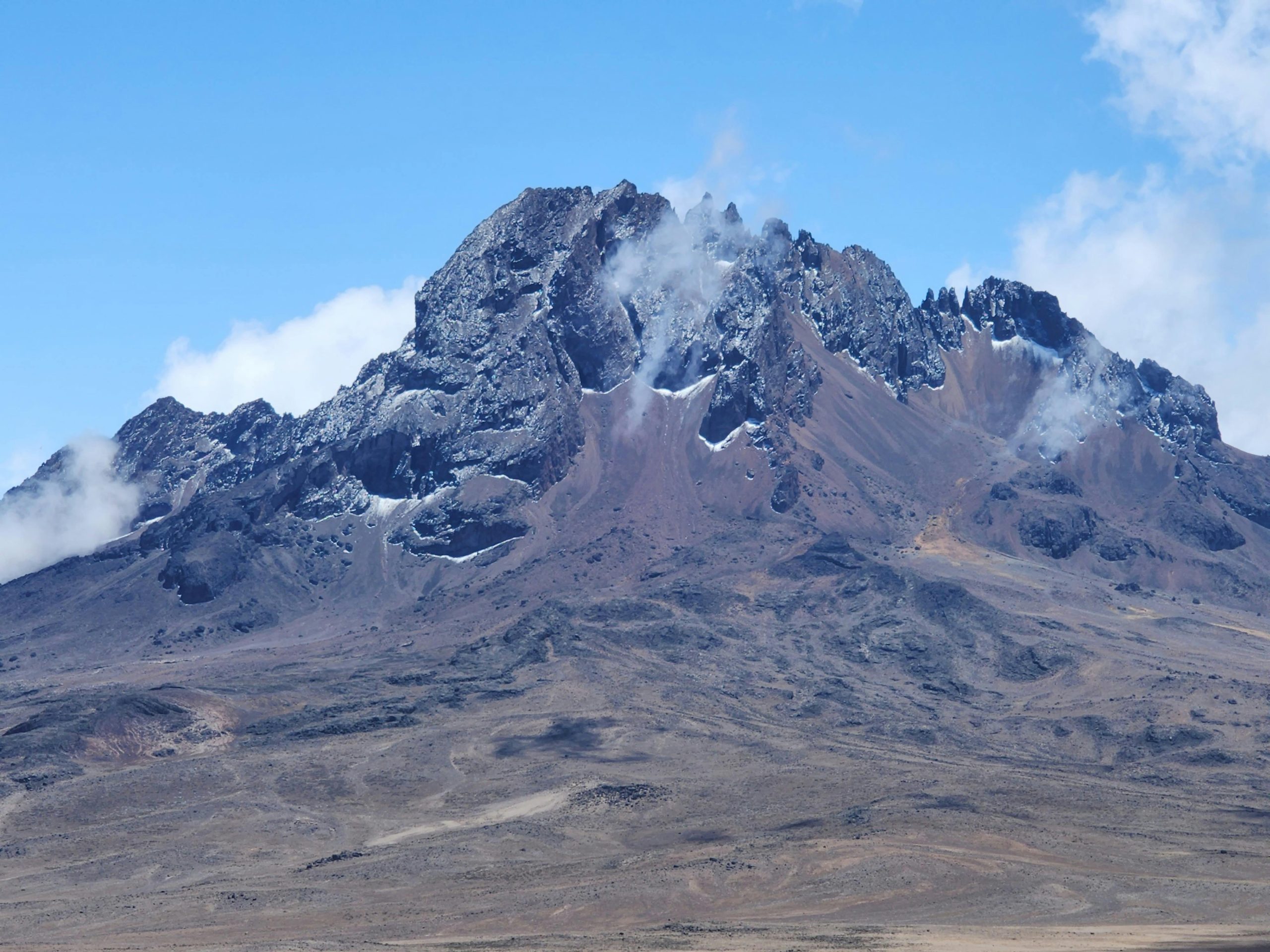
Mount Kilimanjaro. The very name evokes images of mist-shrouded peaks, vast African plains, and the ultimate trekking challenge. Standing as the highest point on the African continent, “Kili” is a beacon for adventurers, scientists, and dreamers alike. But beyond its legendary status, a fundamental question persists: How tall is Mount Kilimanjaro?
The answer is simple yet multifaceted, involving precise measurements, fascinating geography, and a unique ecological journey that few other places on Earth can offer. In this comprehensive guide, we will delve deep into the altitude of this majestic giant, exploring not just the final number, but the context that makes it one of the world’s most remarkable mountains.
The widely accepted, official elevation of Mount Kilimanjaro’s highest summit is: 5,895 meters (19,341 feet)
This specific point is known as Uhuru Peak. “Uhuru” means “freedom” in Swahili, a fitting name for the culmination of such a liberating physical and mental journey. This height firmly establishes Kilimanjaro as:
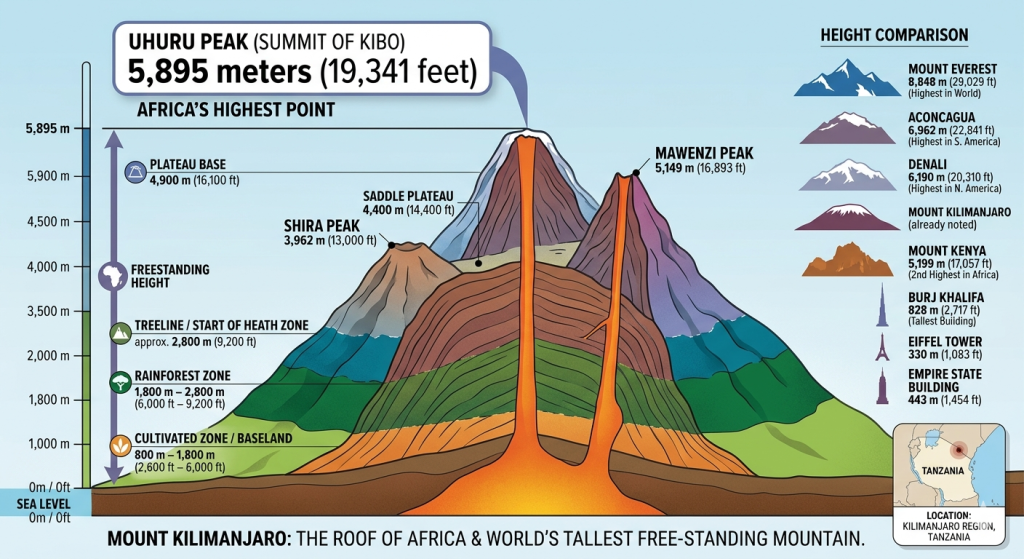
While 5,895 meters is the benchmark, measuring mountains involves complex science. Over the years, technology—from early trigonometric surveys to modern GPS—has yielded slightly different results. Despite minor historical variations, the 5,895-meter mark remains the international standard.
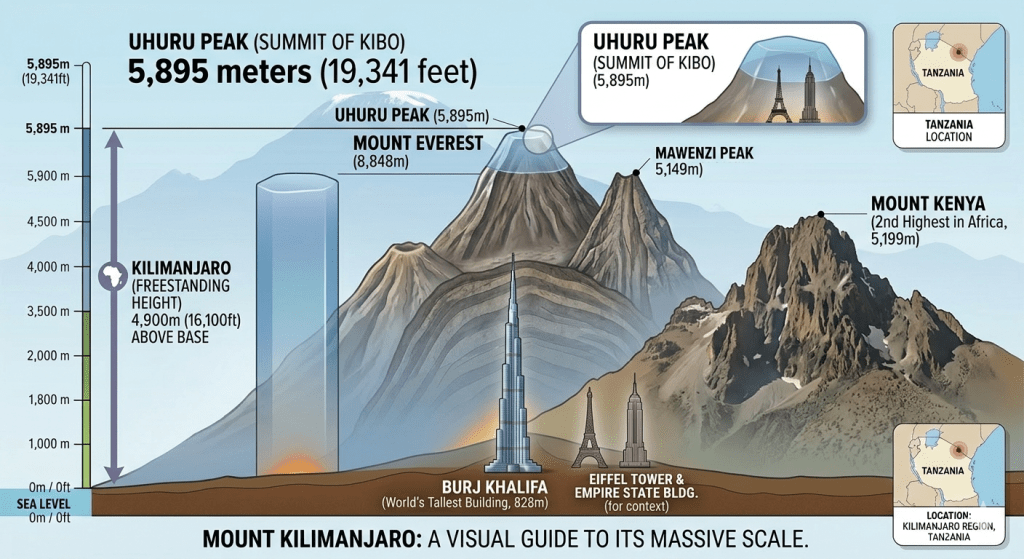
To grasp the magnitude of 19,341 feet, imagine a commercial airliner. Most planes cruise at around 30,000 to 35,000 feet. When you stand on Uhuru Peak, you are nearly two-thirds of the way** up to that cruising altitude.
| Mountain | Continent | Height (m) |
| Everest | Asia | 8,848m |
| Aconcagua | S. America | 6,961m |
| Denali | N. America | 6,190m |
| Kilimanjaro | Africa | 5,895m |
| Elbrus | Europe | 5,642m |
| Vinson | Antarctica | 4,892m |
Unlike Everest, which rises from the Tibetan Plateau (already thousands of feet above sea level), Kilimanjaro rises directly from the relatively flat African plains. This means that when you climb Kilimanjaro, you are ascending nearly 4,900 meters (16,000 feet) from the plain to the peak. > Ready to stand on the Roof of Africa? > [Download our Detailed 7-Day Itinerary & Route Comparison Guide]
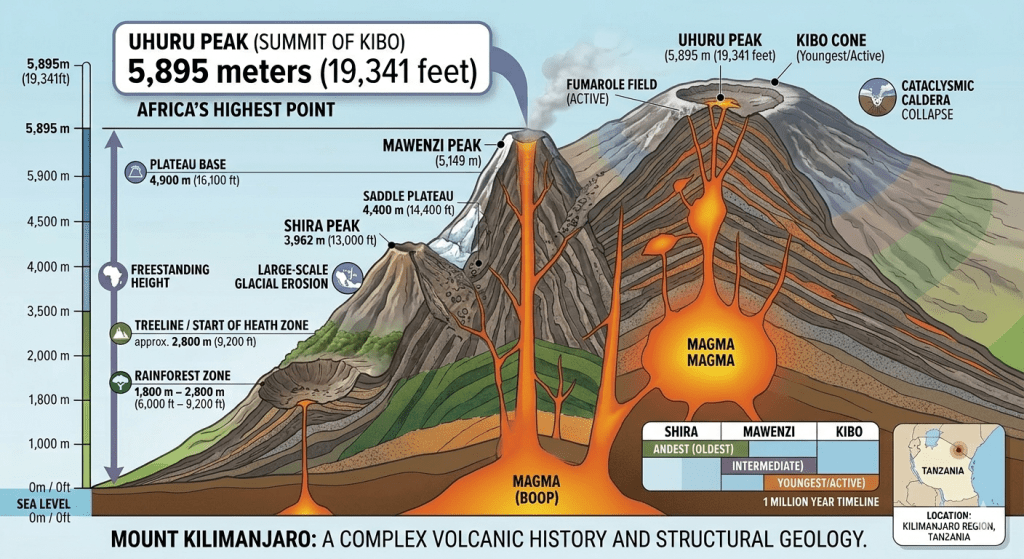
Kilimanjaro is a stratovolcano complex composed of three distinct volcanic cones:
Shira (3,962m): The oldest cone, now a collapsed, eroded plateau.
Mawenzi (5,149m): A rugged, jagged peak that requires technical climbing skills.
Kibo (5,895m): The youngest and tallest cone, home to Uhuru Peak. It is currently dormant, with active steam vents (fumaroles) in its crater.
Climbing Kilimanjaro is metaphorically described as walking from the equator to the North Pole in a matter of days. Because of its height near the equator, it features five distinct ecological layers:
The journey begins in the fertile lower slopes. Lush greenery and volcanic soil support local farming, particularly coffee and bananas.
As you enter the National Park, you are enveloped by dense montane forest. This is the wettest zone, filled with moss-covered trees, blue monkeys, and exotic birds.
Above the treeline, the forest gives way to open, prehistoric landscapes. Here, you find the iconic Giant Lobelias and Dendrosenecio (Giant Groundsels) that look like something from another planet.
A stark, barren wilderness of volcanic rock and deep silence. Vegetation is minimal, and the air grows thin. Oxygen levels here are roughly 50% of what they are at sea level.
The final ascent leads to a world of eternal ice, blue-tinted glaciers, and permanent snow. Temperatures can drop to -20°C as you make your way to Uhuru Peak.
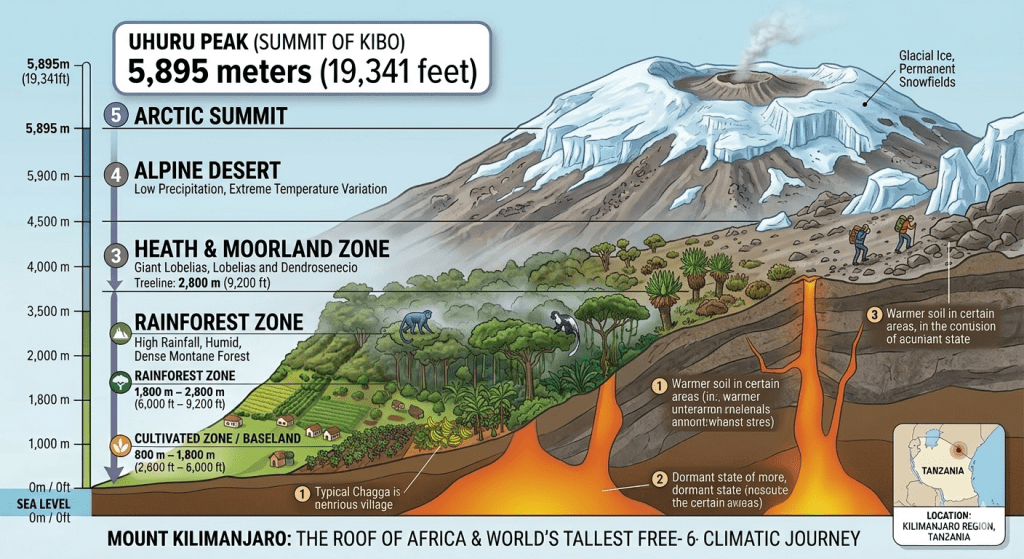
Beneath the Kibo cone lies a complex system of dormant magma chambers and branching conduits. The mountain was built by successive layers of hardened lava and ash over a *1 million-year timeline*. While the eruptions have stopped, the fumarole fields near the crater rim prove that the mountain is still geologically alive.
Understanding the height of Kilimanjaro is the first step toward conquering it. At 5,895 meters, it is a challenge of endurance, acclimatization, and spirit.
| Route | Days | Success | Best For… |
| Lemosho | 7-8 | 90% | Acclimatization |
| Machame | 6-7 | 85% | Fit Hikers |
| Rongai | 6-7 | 80% | Rainy Season |
| Marangu | 5-6 | 50% | Hut Sleeping |
The temperature at the summit is extreme. Our expert-vetted gear list ensures you stay safe and warm.
[Send Me the Ultimate Packing Checklist PDF]
Standing at 19,341 feet isn’t just a hike—it’s a life-changing milestone. Our guides maintain a 95% summit success rate and are certified in high-altitude medicine.
Join our next Small Group Expedition:
Next Trip: June 15 – June 22 (Full Moon Summit)
Availability: Only 3 spots remaining!
Price: All-inclusive packages from $1750.
